

A strong patient-physician relationship is essential to overcoming the confusion and fear associated with a breast cancer diagnosis and becoming an empowered self-advocate.
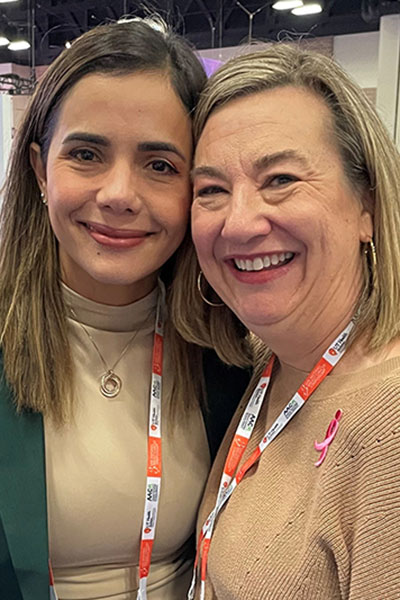
Patient advocate Laurel Pointer, the Director of Community Marketing for Susan G. Komen, discussed that relationship with her physician, Marcela Mazo Canola, MD, a medical oncologist specializing in breast cancer at the Mays Cancer Center at UT Health San Antonio. Read the first half of that conversation, published prior to the San Antonio Breast Cancer Symposium®.
In the second half of the conversation, below, Dr. Mazo Canola provides candid thoughts on when patients and physicians “agree to disagree,” and she explains the benefits of setting early expectations regarding potential treatment-related adverse events. Pointer discusses the value of resource exploration and the positive impact of clinical trial research on her own family.
Since open and honest communication is key in the patient-physician relationship, what should patients discuss with the care team regularly?
Pointer: Talk about everything! Tell your care team what your life is like and what else — outside of cancer — is going on. Treatment schedules may not be flexible, so let your provider know if you can’t get to your appointment because you don’t have childcare or transportation. There are services that can help with that. Susan G. Komen, for example, offers grants that help with transportation and housing costs for patients who don’t live near their cancer center. The American Cancer Society has financial assistance grants so a person doesn’t have to choose between buying groceries or filling prescriptions. Let the system help you find those resources. No one can help you if you don’t speak up.
Dr. Mazo Canola: That is so true. I want to know about my patients’ challenges and goals. Occasionally, I will have a newly diagnosed patient tell me that they have a major trip coming up. Most of the time, I will work with the rest of the care team to accommodate that. However, there are situations where it might be unsafe for a patient to travel, so I will write a letter to the airline if necessary to help the patient reschedule. Maybe I’m blessed to work with an amazing group of women that I respect and admire very much, but I know that all of us truly really want to help patients get through breast cancer in any way that we can. Sometimes that will mean calling in a social worker for a patient who is depressed or asking a patient navigator to help the patient find financial resources, but we’re always there to help care for the patient holistically.
Pointer: For me, that holistic care started with that hug when I first walked through Dr. Mazo’s door. It was what I needed as a person and as a patient. And I guarantee you that those on a patient’s care team understand that life needs to go on, despite breast cancer. They will do whatever they can to help you meet your goals — all you have to do is tell them what matters to you.
Why is it important to set expectations about potential adverse events? In turn, why is it critical that patients be open and honest about any treatment-related side effects they experience?
Pointer: Our doctors are there to help us make those shifts in care that make a huge difference in quality of life. Patients have to be willing to talk about adverse events, though, because the care team can’t fix what they don’t know. It is important to be open and honest through every step of your care. Anytime the care provider asks you a question, tell the truth. You may be embarrassed to say something out loud, but that goes back to being your own advocate. You have to speak up for yourself because if you don’t, who will?
Dr. Mazo was very clear about the need for proactive management of menopausal symptoms that were going to be caused by the gonadotropin-releasing hormone agonist that was essential in my treatment plan. Those symptoms are the things that we have ongoing conversations about, whether it be the joint pain, brain fog, or the night sweats, as my menopausal symptoms are fluid. I am realizing now that so much of what I had thought was related to my cancer treatment is actually related to menopause, but those things go hand in hand for me.
Dr. Mazo Canola: I think Laurel has hit the nail on the head in the sense that honest communication is so important. We, as providers, try to discuss potential treatment-related side effects from the very beginning. I tell my patients that even though these side effects I’m listing are common, that doesn’t mean that all of them are going to actually occur. I also make sure to explain that some side effects might be very intense at the beginning but, as time goes by, we will find that sweet spot between therapy and quality of life. But it is that communication, it’s that back and forth, that allows us to identify problems and then find a way together to fix them. If the patient doesn’t tell me that they are having issues being intimate with their partner because it’s embarrassing, then I can’t help.
Patients also sometimes don’t discuss side effects out of fear that the conversation will lead to a dose or schedule adjustment, which they worry might affect the efficacy of the treatment. I think it comes down to knowing the evidence. The best thing that I can tell my patients is that their safety is not negotiable. For example, if a patient has been on chemotherapy for three cycles and they are having the worst neuropathy of their life, that patient is going to eventually discontinue therapy. So that leaves us with three or four cycles and that’s it, instead of doing smaller doses over more time. Most of the studies in breast cancer on dose and schedule alterations have shown that following the FDA-approved modifications for a specific treatment results in equivalent efficacy to the full dose or regular schedule.
I think presenting patients with data and telling them early that if we get into the muddy waters of something being unsafe for them, we won’t be able to continue the therapy — for good reasons — really helps them understand the importance of honest communication. I tend to experience this a lot with patients with metastatic disease and in those who are at high risk of recurrence. The treatments for these groups have side effects such as diarrhea, nausea, and vomiting. I can tell from routine labs if their potassium is severely low, around 2.5 mmol/L, that they are having more diarrhea than they’re telling me. So I can tell that there is fear about dose reduction and that I need to initiate the conversation.
Why are clinical trials so important to patient care?
Pointer: I think a lot of patients only really know clinical trials as a last-ditch effort, which is an outdated but still-present perception. I know that Komen and so many other patient advocacy organizations are trying to help change that perception. In my case, I had stage 1 disease but qualified for a clinical trial, and it was actually a very positive experience.
Dr. Mazo Canola: In my group, we have five breast medical oncologists, and we are all co-investigators in each other’s trials. So we all actively enroll patients on clinical trials. We even have flow sheets in our workroom that walk through the different trials that we have, depending on the cancer type, so that the full care team is aware and we can all actively discuss trials with patients.
To Laurel’s point, I feel like we have so much to do when it comes to educating the community about the importance of clinical trials and how they help us de-escalate or escalate treatment or be more precise with treatment. I tell my patients that we, as a breast cancer community, only move forward if we do this together because whatever we’re doing today is going to help whoever’s going to be sitting on that exam table in 10 years.
Pointer: I agree! I personally want the journey to be easier for the next person. I trust that my doctors aren’t going to put me into any situation that’s going to harm me. Any research that we participate in together is going to take care of me and it’s going to be for the betterment of the next patient.
One of the beautiful things about the clinical trial that I was in was that it helped me get more timely relief from menopausal symptoms that were related to treatment. If I hadn’t been part of that clinical trial, I would’ve had to wait six weeks in between my regular visits, so I really think the trial facilitated more and faster communication that resulted in me feeling better. So there’s the beauty of that interaction.
I got to tell a bunch of researchers last year to keep going, that we were making progress. When my family journey started 30 years ago, Herceptin wasn’t invented. If it had been, my mom wouldn’t have had a second cancer journey. When my mom’s sister was diagnosed, we said, “Do we need to do genetic testing?” And the doctor said, “No, you don’t meet the requirements for BRCA1 or BRCA2,” which were the only two genetic mutations that we were aware of at that time. Fast forward 10 to 15 years later, and it turns out that I have a CHEK2 mutation, which we now know increases risk for developing breast cancer.
So the journey is long, but it’s worth it. Researchers need to keep going because they are impacting families for generations. Someday we will hopefully get to where no one has to die of breast cancer. I think that, with each day that research is happening, we are getting closer to that goal.