The 2025 San Antonio Breast Cancer Symposium® concluded Friday, December 12, by adding clinical context to exciting and potentially practice-changing data across the continuum of breast cancer. During View from the Trenches: What to Do on Monday Morning, an expert panel discussed treatment escalation and de-escalation approaches in ductal carcinoma in situ (DCIS); omission of sentinel lymph node biopsy (SLNB) and a novel oral endocrine therapy option in early-stage invasive disease; and expanding treatment options in the metastatic disease setting.
The session will be available to registered SABCS® 2025 participants through March 31, 2026, as an on-demand recording on the symposium’s virtual platform.
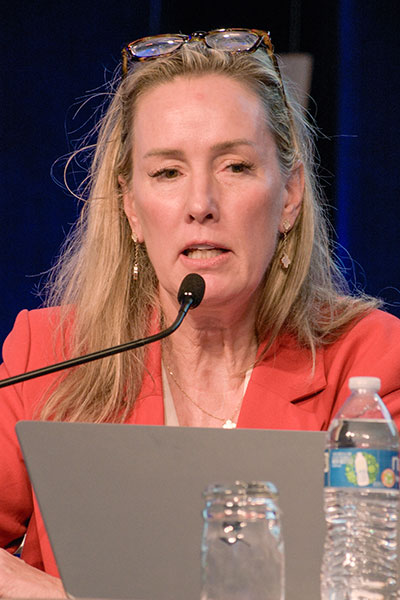
Heather L. McArthur, MD, MPH, Clinical Director of Breast Cancer and Komen Distinguished Chair in Clinical Breast Cancer Research at University of Texas Southwestern Medical Center, moderated the session. The panel included:
- Judy C. Boughey, MD, Chair of Breast and Melanoma Surgical Oncology at Mayo Clinic;
- Jonathan Blake Strauss, MD, MBA, Vice Chair of Operations of Radiation Oncology and Professor at the Feinberg School of Medicine at Northwestern University;
- Lajos Pusztai, MD, DPhil, Professor of Medical Oncology at Yale University and Co-Director of the Genetics, Genomics, and Epigenetics Program at Yale Cancer Center;
- Komal L. Jhaveri, MD, Patricia and James Cayne Chair for Junior Faculty, Section Head of the Endocrine Therapy Research Program, and Clinical Director of the Early Drug Development Service at Memorial Sloan Kettering Cancer Center; and
- Julia Maues, a patient advocate and Co-Founder of GRASP Cancer.
Key lessons in DCIS management
While the current standard of care for DCIS includes surgery, with or without radiation and/or antiestrogen therapy, recent studies, such as the LORETTA trial presented during General Session 2 at SABCS 2025 and the COMET trial presented at SABCS 2024, have evaluated the potential of less intensive approaches in select patients with low-risk DCIS.
In this context, Dr. McArthur asked panelists to weigh in on their comfort with the use of endocrine therapy alone, without surgical resection, for patients with low-risk hormone receptor (HR)-positive, human epidermal growth factor receptor 2 (HER2)-negative DCIS.
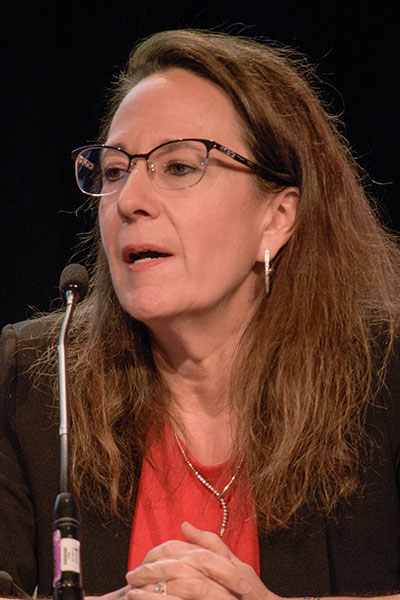
Dr. Boughey pointed out that the LORETTA trial did not meet its primary endpoint — the five-year cumulative incidence proportion of ipsilateral invasive cancer (CIPIC) in patients receiving tamoxifen alone without surgery exceeded the prespecified 7% threshold, although five-year CIPIC remained low at 9.8%.
She highlighted the importance of shared decision-making as evidence continues to evolve regarding potential de-escalation strategies in low-risk DCIS.
Maues reiterated the importance of shared decision-making, noting that the entire clinical care team has a role to play in patient engagement and education, which can facilitate improvements in adherence to hormone therapy.
Other panelists agreed that shared decision-making and better communication, along with improvements in supportive care, have and can continue to foster incremental changes in treatment adherence.

Dr. Strauss discussed the tumor bed boost radiotherapy approach in low-risk DCIS, referencing results from the phase III Big 3-07/TROG 07.01 trial presented in General Session 2 at SABCS 2025.
“The boost worked,” he noted. “Whole breast radiotherapy cuts our risk of recurrence by half, and the boost cuts it in half again.” He added that these findings are practice-confirming, as radiotherapy approaches are tailored based on the recurrence risk in contemporary practice.
Important insights in early-stage invasive disease
Potentially practice-changing data from the phase III lidERA trial comparing the novel oral selective estrogen receptor degrader (SERD) giredestrant to standard-of-care endocrine therapy in HR-positive, HER2-negative early-stage breast cancer were presented in General Session 1 during SABCS 2025.
“These are the first positive data for an oral SERD in the adjuvant setting,” Dr. McArthur said. “Notably, there are a number of other adjuvant oral SERD trials that are ongoing.”
She added, “This is the first improvement in adjuvant endocrine therapy that we’ve seen in 20 years — a 30% proportional improvement in [invasive disease-free survival] and other endpoints.”

Dr. Pusztai echoed the excitement, “I think this is wonderful news.”
Dr. Jhaveri mentioned that a readout from a subgroup of patients in lidERA who received giredestrant with CDK4/6 inhibitors may further clarify optimal therapy approaches in early-stage breast cancer.
The panel also highlighted new evidence on de-escalated surgical approaches — omission of SLNB and axillary dissection — based on the findings from the BOOG 2013-08 trial and secondary endpoint results from the INSEMA study, respectively, both featured in General Session 2.
“In terms of substituting, essentially, sentinel lymph node surgery [with] axillary ultrasound, I think many of us have been watching the data” in the SOUND and INSEMA trials, Dr. Boughey said. “The BOOG trial really adds to that body of literature.”
The biggest challenge, she added, is to make sure that de-escalating surgery doesn’t inadvertently result in escalation of radiation therapy. Dr. Strauss concurred.
The key message: Multidisciplinary team discussions are important to balance escalation and de-escalation in the context of multimodal therapies for early-stage breast cancer.
The panel also discussed new evidence that may inform management of early-stage HER2-positive and triple-negative breast cancers, including exploratory analyses from the ALTTO trial; pooled analyses of the BrighTNess, CALGB 40603 (Alliance), and GeparSixto clinical trials; and the RJBC-1501 trial.
Lessons learned in the metastatic disease setting
Dr. McArthur shared a brief historical overview of the evolution of the therapeutic landscape in the metastatic disease setting and noted recent advances, especially in first-line treatment of patients with HER2-positive metastatic breast cancer — significant progression-free survival improvements seen in the DESTINY-Breast09 trial on trastuzumab deruxtecan (published earlier in 2025), results from the PATINA trial on palbociclib along with anti-HER2 therapy and endocrine therapy (shared at SABCS 2024), and findings from the HER2CLIMB-05 trial on combination first-line maintenance therapy with tucatinib along with trastuzumab and pertuzumab (shared during General Session 1 at SABCS 2025).
She posed this question: “With all of these options — which are so great to have so many options in such a relatively short period of time — is there an optimal first-line therapy, in your mind, for HR-positive, HER2-positive disease versus HR-negative, HER2-positive disease? And how are you making those decisions?”
“I think these are great data,” Dr. Jhaveri replied. “It’s nice to have options — multiple options for different subtypes as well. It’s good to have that because I don’t think any one size will fit all, even when it comes to first-line HER2-positive disease.”

For patients with HR-positive, HER2-positive disease with limited visceral burden, Dr. Jhaveri said a PATINA-like regimen might be preferred. For patients with HR-negative disease, higher visceral burden, recurrence, or brain metastases, the DESTINY-Breast09 regimen may be more appropriate.
While some panelists said that more data are needed to clarify the optimal first-line maintenance approach, others expressed willingness to incorporate the HER2CLIMB-05 regimen into practice for patients with estrogen receptor-negative, HER2-positive metastatic disease.
The panel also discussed the role of baseline brain magnetic resonance imaging (MRI) assessments for patients with de novo metastatic disease. While screening brain MRIs are not performed uniformly in current practice and are not recommended within U.S. guidelines for all patients in this setting, evolving data and ongoing studies may help clarify how best to integrate baseline brain MRI assessments.
Rounding out the discussion of updated evidence, the panel reviewed data from the EMBER-3 and evERA trials in HR-positive, HER2-negative metastatic disease — another rapidly evolving therapeutic space. Data from both trials were shared during General Session 3 at SABCS 2025.
The panelists underscored the importance of treatment individualization for the HR-positive advanced disease setting. Clinicians must account for many factors, including de novo presentation, current disease, tumor burden, the site and burden of metastases (including in the brain), and tumor molecular profiles.

Dr. Jhaveri urged clinicians to conduct biomarker profiling – even in light of data showing that giredestrant was effective in patients regardless of ESR1 mutations — as the molecular profiling findings can provide prognostic information and inform, not only the current, but also subsequent lines of treatment.
Speaking about the rapidly changing landscape from the perspective of patients and advocates, Maues pointed out that although quality-of-life data were presented at SABCS 2025, the timing of those assessments may need adjustments.
“One of the things that patients talk about all the time is, when my doctor sees me, it’s already time to get the new treatment, and I’m already feeling better. So, no one’s asking me after a week what my side effects are. I think that’s just very important,” she said. “We’re not taking advantage of [electronic patient-reported outcomes] and many other ways to measure it.”