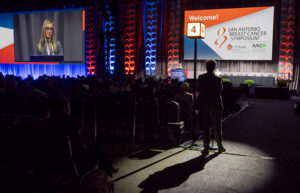
Patients with breast cancer are the leaders of their own treatment and survivorship, speakers emphasized during the inaugural SABCS Salutes Patients and Survivors event on the eve of the 2025 San Antonio Breast Cancer Symposium.
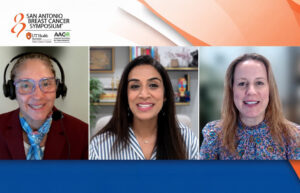
“Someone like me may be an expert on breast cancer, but there is only one expert on you — and that is you. You’re the captain; we’re helpers and navigators,” said Ann H. Partridge, MD, MPH, Professor at Harvard University and Eric P. Winer, MD, Chair in Breast Cancer Research at the Dana-Farber Cancer Institute.
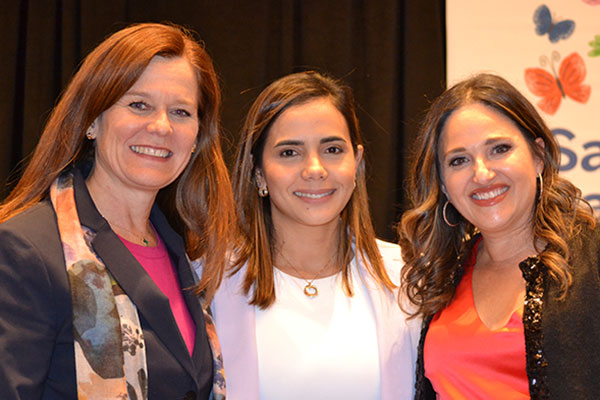
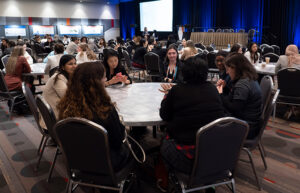
Dr. Partridge and Melissa Berry, Founder of Cancer Fashionista and a triple-negative breast cancer survivor, spoke to an audience of more than 100 attendees on Monday, December 8, in San Antonio. Marcela Mazo Canola, MD, a medical oncologist specializing in breast cancer at the Mays Cancer Center at UT Health San Antonio, moderated the conversation. Organizers described the new pre-symposium gathering as a celebration to honor and empower patients to navigate their cancer treatment and survivorship to enhance their quality of life.
Collaboration between patients and care teams helps breast cancer survivors “live not just longer, but better,” said Dr. Partridge, who is also Director of the Adult Survivorship Program and Co-Founder and Director of the Program for Young Adults with Breast Cancer at Dana-Farber. This collaboration is best achieved by clear communication between patients and their physicians about the patient’s priorities and the physician’s rationale for recommending a particular treatment regimen.
“It’s a process you figure out over time, but you can make decisions with the support of your care team based on your own preferences and values,” Dr. Partridge said. “Every step of the way you can ask: ‘What is the benefit of this? What are the risks? Is this for me?’”
Berry said her most important message for attendees was to “be kind to yourself” during the diagnosis, treatment, and recovery processes. She built a national audience through writing and speaking about beauty, lifestyle, and self-care products for patients with cancer and survivors. She told the audience that when she was diagnosed with stage 1 breast cancer more than a decade ago, she struggled with issues of self-image and self-identity common to many patients.
“I didn’t need to look like a supermodel, but I wanted to look like myself,” Berry recalled. “That may seem easy to dismiss when you are going through something so scary, but you want to be able to maintain your dignity.”
Berry added that a patient should be free to define what is necessary for their dignity, well-being, and self-identity, and that these requirements can be different for each person or at various stages in the breast cancer journey.
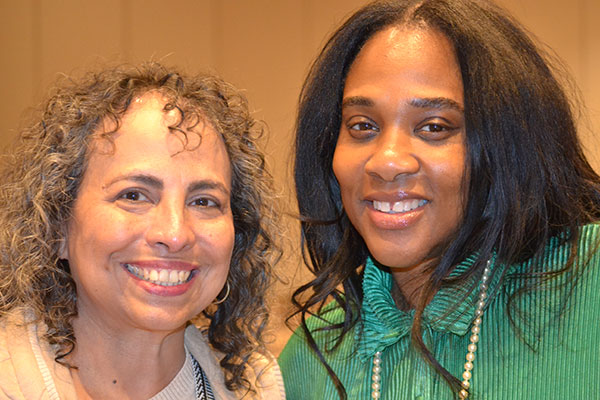
This message resonated with Veronica Laurel, a San Antonio community member with The Breasties advocacy group. During the open dialogue portion of the event, Laurel thanked Berry, whose online resources helped her find her own community shortly after her diagnosis.
“When I was diagnosed in 2020, I felt there wasn’t a lot for me to connect with,” Laurel said. “I turned to the online community and started following Melissa. That was so important to find people to help me look pretty, feel my best, and find people of color like me.”
Laurel noted that the SABCS Salutes Patients and Survivors celebration — along with the Advocacy Pavilion and the inclusion of advocate panelists in sessions — is another way that SABCS creates dialogue between the medical and patient communities.
“It’s important for us to be able to have conversations with physicians and scientists at SABCS. And I think being able to directly hear our experience helps them be better caregivers,” Laurel said. “The most important thing I heard today was the acknowledgment that survivorship is something we are learning, something that has a bigger focus, so that we can discuss available options and ways to talk with and question our physicians.”
Laurel was joined in the audience by Trish Michelle, Chief Community Officer for The Breasties. Michelle said she saw the SABCS Salutes Patients and Survivors event as setting the stage for much-needed dialogue about the evolution of survivorship.
“I appreciate that SABCS organizers continue to add to their programming. The health industry and the oncology space in general is doing a lot of catch-up as it pertains to survivorship. It had been getting people to just survive treatment, but now more and more of us are trying to navigate what survivorship looks like, and we’re all figuring it out together,” Michelle said.
“It’s helpful to have these conversations where we feel seen and heard,” she added. “So, I appreciate this event and look forward to seeing even more next year.”