A special session on Tuesday, December 9, at the 2025 San Antonio Breast Cancer Symposium® furthered dialogue about lobular breast cancer — one of the most common histological subtypes of breast cancer, making up 10-15% of all diagnoses.
Special Session 2: Lobular Breast Cancer Updates will be available to registered SABCS® 2025 participants through March 31, 2026, as an on-demand recording on the symposium’s virtual platform.

Steffi Oesterreich, PhD, Professor of Pharmacology and Chemical Biology at the University of Pittsburgh Medical Center (UPMC) and Co-Leader of the Cancer Biology Program at UPMC Hillman Cancer Center, and Marleen Kok, MD, PhD, Medical Oncologist and Breast Cancer Immunotherapy Group Leader at the Netherlands Cancer Institute, co-moderated the session.
“Over the last decade, it’s really great to see there’s a significant increase in the number of papers on ILC (invasive lobular carcinoma),” said Dr. Oesterreich, who shared that more than 120 abstracts featured at SABCS 2025 included the term “lobular breast cancer.”
The session was sponsored by the Lobular Breast Cancer Alliance (LBCA), an organization dedicated to educating about lobular breast cancer.

“I am so proud to have this platform, this voice to share that there needs to be more for lobular breast cancer,” said Panelist Flora Migyanka, a patient advocate, a founding advocate of the LBCA, a member of the LBCA Patient Advocate Advisory Board, and the founder of the Dynami Foundation.
ILC-specific trial lessons
Philippe Aftimos, MD, Clinical Trials Development Leader at Institut Jules Bordet, shared ILC-specific lessons learned from trials — including those studying endocrine therapy, ERBB2 gene mutations, the PI3K-AKT-mTOR pathway, ROS1 inhibitors, and immunotherapy — and how those findings may inform future trial designs.
He noted that responses to many therapeutics have been found to differ between ILC and other types of breast cancer.
In the phase III PENELOPE-B trial, for example, final survival results concluded that adding palbociclib to endocrine therapy did not significantly improve outcomes for the overall population of patients with high-risk hormone receptor (HR)-positive, human epidermal growth factor receptor (HER2)-negative breast cancer and residual disease after neoadjuvant chemotherapy.
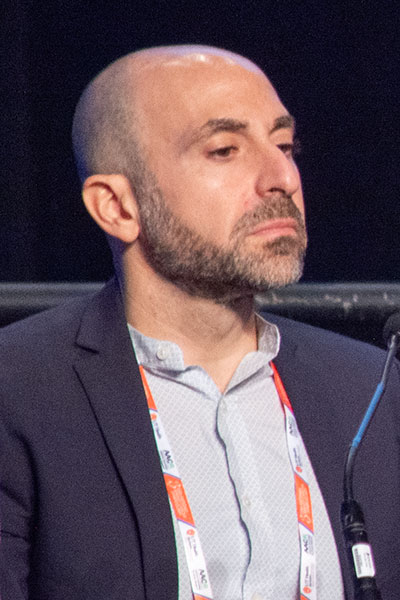
“However, when you looked at the exploratory analysis in ILC — and the caveat here is there was no central pathology review, even though the investigators corrected for that, looking at CDH1 expression — there was a benefit in invasive disease-free survival and overall survival with palbociclib in ILC,” Dr. Aftimos said.
Clinical trials may need to incorporate endpoints appropriate to ILC, he added, pointing to data from the ROLo and ROSALINE clinical trials that suggested that responses in these cancers were best measured radiographically.
Dr. Aftimos also acknowledged the many recent advances in selective estrogen receptor degraders (SERDs), including results from the lidERA clinical trial reported on Wednesday during General Session 1, but noted that it still remains to be seen how effective SERDs will be for ILC.
“It’s interesting to see how these SERDs will work in ILC,” Dr. Aftimos said. “One would say that we would expect a lower prevalence of ESR1 mutations in ILC; however, given the difference in the hormone sensitivity between ILC and IDC (invasive ductal carcinoma), we might not need ESR1 mutations to see benefit with these novel SERDs.”
Diagnostic criteria

Anne Vincent-Salomon, MD, PhD, Professor and Director of the Institute of Women’s Cancers at Institut Curie, reviewed ILC diagnostic criteria, highlighting classic ILC and variants of the disease recognized by the World Health Organization (WHO). In up to three-fourths of ILC cases, classic and variant patterns are mixed within a single tumor, she said.
Dr. Vincent-Salomon also touched on the use and interpretation of E-cadherin staining in ILC diagnosis. E-cadherin loss is observed in 85% of ILC cases, and E-cadherin immunohistochemistry has been shown to improve diagnostic agreement, she reported, adding that E-cadherin negativity is an inclusion criterion for ILC-focused clinical trials.
“The loss of E-cadherin expression greatly improves the reproducibility of ILC diagnosis, but it remains a nonessential criterion for the WHO,” she said, noting that up to 23.5% of ILCs are E-cadherin-positive. However, in those cases, E-cadherin usually presents abnormally or with less intense staining.
Additionally, she noted, most ILCs are luminal tumors, although triple-negative and HER2-positive ILCs exist.
A new, architecture-based classification of ILC variants is undergoing validation, Dr. Vincent-Salomon said. Artificial intelligence (AI)-based models are also under development, and a new classification of ILC variants based on the tumor microenvironment is emerging.
Novel ILC subtypes with therapeutic implications

Christos Sotiriou, MD, PhD, Chef de Clinique at the Institut Jules Bordet and Director of the Bordet Cancer Research Laboratories, shared research from his group that used morphological, spatial, and gene expression data to classify ILCs into four distinct subtypes. The four subtypes are normal-stroma enriched (NSE), proliferative (P), androgen-receptor enriched (ARE), and metabolic-immune enriched (MIE).
Dr. Sotiriou discussed how categorizing ILCs into these subtypes could have clinical implications, such as more refined patient stratification for treatment. Patients with the ARE subtype, for example, may be eligible for androgen receptor modulators, and patients with the MIE subtype may benefit from metabolic inhibitors or macrophage-targeting therapies.
Consistent with this, Dr. Sotiriou and colleagues found that the MIE subtype was sensitive to the PIK3CA inhibitor taselisib — regardless of PIK3CA mutation status — due to the enrichment of M2 macrophages with increased PI3K signaling in this subtype.
“Taselisib may act through a dual mechanism targeting tumor cells via the PI3Kα subunit and PI3Kγ in macrophages,” he said, explaining that this promotes macrophage repolarization and strengthens anti-tumor immunity, particularly in the MIE subtype.
Adjuvant chemotherapy and clinical decision-making

Otto Metzger, MD, Medical Oncologist at Dana-Farber Cancer Institute and Assistant Professor at Harvard Medical School, addressed an ongoing controversy about the role of adjuvant chemotherapy in the treatment of ILC.
While studies have shown that patients with ILC experience lower rates of pathologic complete response (pCR) after chemotherapy, Dr. Metzger argued that a lack of pCR benefit may not translate to survival outcomes for ER-positive breast cancers with low-proliferative features, including ILC.
“I think we need to be careful with the statements that say chemotherapy has no value for lobular cancer, but at the same time always interpreting this with caution and knowing that it’s a subtype of breast cancer that has better prognosis in the long run, so there is a lot of space for thoughtful clinical judgement,” Dr. Metzger said.
He explained the importance of predictive biomarkers to guide treatment decisions about chemotherapy. Risk stratification that factors in tumor size and nodal status continues to be a key input in clinical decision-making, he noted, adding that genomic tools have also shown utility for patients with limited disease burden.
Dr. Metzger also emphasized that, for patients with ILC that has favorable clinical and biological features, “there is little room to show that chemotherapy adds benefit. But this is different than saying that chemotherapy doesn’t work.”