

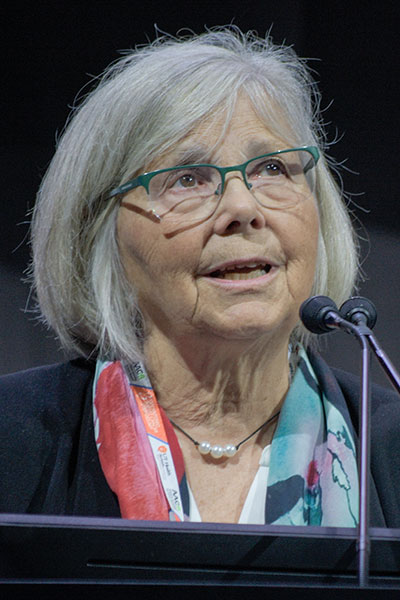
Renowned cancer researcher Joan Brugge, PhD, outlined goals to identify molecular precursors to cancer, isolate their vulnerabilities, and eliminate them during a plenary lecture on Friday, December 12, at the 2025 San Antonio Breast Cancer Symposium®.
Dr. Brugge, Louise Foote Pfeiffer Professor of Cell Biology and Director of the Ludwig Center at Harvard Medical School, said the possibility of achieving these breakthroughs is rooted in years of collaborative, informative studies that have shed light on the role of chromosomal alterations in breast cancer development.
“It is a significant challenge,” she said, “but I think that we now have some findings that provide substantive information that could provide a starting point for developing strategies that could — potentially, down the road — lead to prevention and early detection approaches.”
The session, Genetic and Epigenetic Determinants of BRCA1/2 Tumorigenesis, will be available to registered SABCS® 2025 participants through March 31, 2026, as an on-demand recording on the symposium’s virtual platform.
In an effort to find early precursors of breast cancer, Dr. Brugge and colleagues characterized and catalogued the different subsets of cells within normal (noncancerous) breasts. Single-cell DNA sequencing of noncancerous breast cells revealed that a small population of luminal cells in almost all breasts harbored some of the most common copy number alterations (CNAs) that are found in breast cancer, such as the chromosome 1q gain.
The cells with these alterations were not hyperproliferative, but Dr. Brugge posited that “these gains or losses of chromosome arms increase the fitness of these cells such that they are selected over time,” explaining that cells with these particular alterations may have a lower probability of undergoing cell death during the expansion and contraction of breast epithelial cells that occur during the menstrual cycle.
While most cells with these alterations will not become breast cancer, some may serve as the cells of origin for many breast cancers — an idea that is supported by recent studies, Dr. Brugge said.
Furthermore, genome sequencing of breast cancers from carriers of BRCA1/2 mutations revealed that almost all of these cancers contained a chromosome 1q gain.
“This strongly suggests that the gain of 1q is required for tumor formation in BRCA1/2 mutation carriers. And it supports the conclusion that cells with 1q gain are the cells of origin of tumors that arise in BRCA1/2 mutation carriers,” Dr. Brugge said.
Dr. Brugge said that the current accumulation of knowledge has refined understanding of tumorigenesis for the breast cancer field, with a focus on how chromosome 1q gain might lead to tumorigenesis.
She says it is unclear which genes on chromosome 1q are involved in promoting breast cancer development. There are multiple candidates, such as MDM4, MCL1, AKT3, and KDM5B, and others. There are other unanswered questions, such as the impact early CNAs might have on gene expression and cell states.
Dr. Brugge noted that further research on chromosome 1q gain and other CNAs could have clinical implications, including the development of cancer prevention and interception approaches. In addition, expansion of breast cancer precursor cells could signal the growth of a BRCA1/2-mutated tumor or could be used to monitor outcomes in cancer prevention trials, evaluate a therapy’s efficacy, or inform clinical decisions about the timing of a mastectomy.