

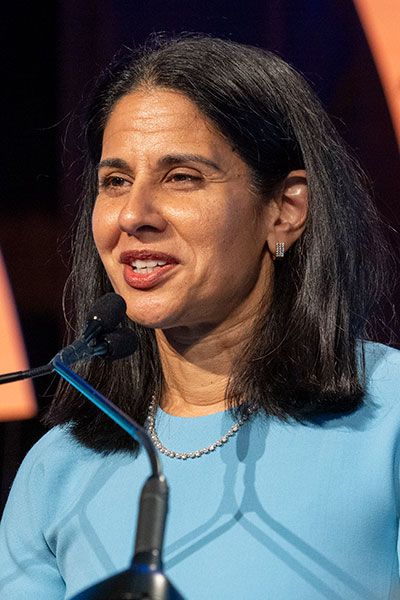
The 2025 recipient of the AACR Outstanding Investigator Award for Breast Cancer Research, Sara M. Tolaney, MD, MPH, transformed the field of breast cancer with her pioneering work on treatment personalization, including innovative clinical trials on optimizing targeted therapies for human epidermal growth factor receptor 2 (HER2)-positive breast cancer.
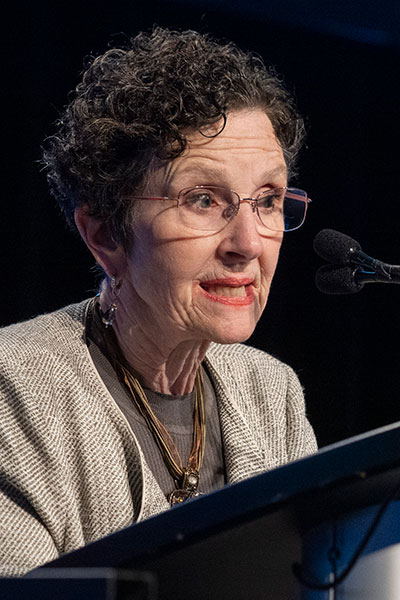
Her career is “a testament to the extraordinary impact that a single visionary physician-scientist can have on the lives of patients and on the trajectory of an entire field,” said Joyce O’Shaughnessy, MD, chair of the award selection committee.
Dr. Tolaney’s APT trial, which demonstrated the efficacy of a less intensive regimen involving paclitaxel and trastuzumab for early-stage, node-negative disease, was a “practice-changing study [that] provided the first evidence that de-escalation could be safe and beneficial for this patient population,” Dr. O’Shaughnessy said.
During an award lecture on Friday, December 12, at the 2025 San Antonio Breast Cancer Symposium®, Dr. Tolaney outlined six core lessons that shaped her career overall, including designing thoughtful clinical studies, such as APT and ATEMPT, that reflect a dedication to rigorous research framed by an acute awareness of patient priorities, comfort, and dignity.
A recording of the lecture will be available on demand for registered SABCS® 2025 participants through March 31, 2026.
Always put patients first
Dr. Tolaney, Associate Professor of Medicine at Harvard Medical School and Chief of the Division of Breast Oncology, Associate Director of the Susan F. Smith Center for Women’s Cancers, and Senior Physician at the Dana-Farber Cancer Institute, credited her mentor at Dana-Farber, Eric Winer, MD, for her focus on patients.
“One of the very unique things that came out when seeing patients with Eric was, it wasn’t just about making a complex therapeutic decision based on what the data showed. It was about getting to know the entire patient. He always wanted to know every detail about them — what they did for a living, whether or not they had children, what their preferences were. And it was about putting all that into context when making a treatment decision for that patient,” Dr. Tolaney said.
This same approach, she learned, should carry into research, with trials always designed with consideration for their betterment of patient lives.
Mentorship is transformative and bidirectional
Dr. Tolaney related important lessons learned from her friendship with a patient, Marla, who was diagnosed with recurrent triple-negative breast cancer and had a germline BRCA mutation but was determined to live long enough to see her three middle-school age daughters graduate from high school. Marla enrolled in two clinical trials, going from treatment to treatment before passing away after living seven years with metastatic cancer and seeing two daughters graduate from high school.
Dr. Tolaney said Marla taught her many lessons, including tips about how to raise teenage daughters, but also medical lessons, such as the critical role tumor biology plays in treatment.
Biology must drive treatment
Understanding tumor biology has been a key factor in Dr. Tolaney’s goal of formulating treatment that might eliminate the need for chemotherapy in some patients. Her work on studies involving the CDK4/6 inhibitor abemaciclib provided key insights toward the goal of replacing effective treatments with even more effective agents.
Dr. Tolaney said that “translating science and seeing initial results in early clinical trials is so critical for us to be able to move agents forward. We really have to be able to push what we are seeing in the laboratory into the clinic.”
Treatment should be tailored toward the individual
Treatments should not only respect patient priorities, such as a desire to protect fertility, but should also be informed by the genetic profile of each patient.
For example, Dr. Tolaney outlined studies tailoring treatment based on a patient’s response to preoperative treatment by using circulating tumor DNA (ctDNA) clearance — patients with ctDNA clearance would receive de-escalated treatment; those with residual disease would receive escalated treatment.
Toxicity matters
Toxicity has tremendous impact on a patient’s quality of life, and the effect of excessive toxicity was one of the factors that led Dr. Tolaney to set up her influential APT trial as a nonrandomized prospective trial.
It is also a key factor in the construction of some of her later studies. Dr. Tolaney described critically examining the traditional categorization of toxicities and, in effect, reconsidering the application of standard Common Terminology Criteria for Adverse Events (CTCAE) toxicity profiles.
In developing the ATEMPT trial, Dr. Tolaney and Ian Krop, MD, PhD, examined the efficacy of trastuzumab emtansine (T-DM1) in stage 1 HER2-positive treatment and established a set of endpoints they called “clinically relevant toxicities,” which were based on how the toxicities might affect patient-reported quality of life.
Teamwork is essential
Finally, Dr. Tolaney said, teamwork has been a critical factor in her career.
“What I have learned is that alone we can do so little, but together, we can do so much,” she said.
Teamwork comes in many forms, including the active role of patient advocates, collaboration with colleagues, and the creation of data repositories to provide the ability to learn from every patient.
About the award
Supported by the Breast Cancer Research Foundation, the AACR Outstanding Investigator Award for Breast Cancer Research was established in 2008 to honor an investigator whose novel and significant work has had or may have a far-reaching impact on the etiology, detection, diagnosis, treatment, or prevention of breast cancer. Such work may involve any discipline across the continuum of biomedical research, including basic, translational, clinical, and epidemiological studies.