

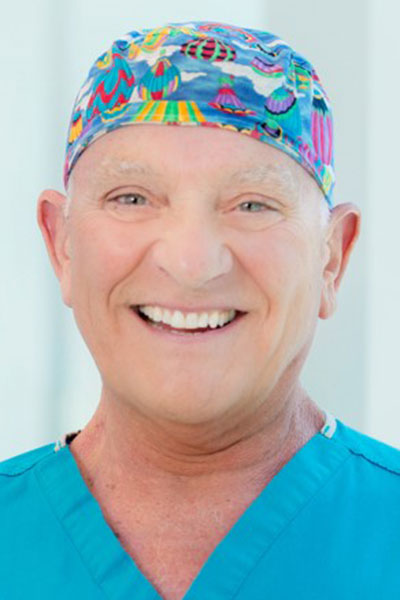
To those in the field of breast cancer, Armando E. Giuliano, MD, is widely recognized for a series of studies beginning in the early 1990s that shaped the standard of care in surgical management of the disease.
But when Dr. Giuliano delivers the William L. McGuire Memorial Award Lecture at 8:55 a.m. CT on Wednesday, December 10, at the 2025 San Antonio Breast Cancer Symposium®, he won’t be detailing the science behind his transformative work on sentinel lymph node biopsy in breast cancer, which has allowed many patients to undergo less aggressive surgical intervention and lead a higher quality of life.
“There’s going to be 10,000 breast cancer specialists in the audience — and they’re all very knowledgeable — so I’m not going to bore them with that!” Dr. Giuliano said with a smile.
Instead, Dr. Giuliano said he will talk about some of the personal and institutional challenges his studies faced and how the field of breast cancer therapy adapts to change.
“I’m going to talk about my experience of trying to change the management of the axilla, how this came about, what happened, what happened to me, why it is so difficult for us physicians to accept change, what personal traits hinder us and what institutional barriers protect and hinder us — and what I think we should do,” Dr. Giuliano said.
For example, Dr. Giuliano’s breakthrough ACOSOG Z0011 study on axillary lymph node removal in limited node-positive breast cancer patients was inspired by the landmark NSABP B-04 trial by Bernard Fisher, MD, that suggested that simple mastectomy (which spares most of the axillary lymph nodes) plus radiation may be just as effective as radical mastectomy in node-positive breast cancer patients, with no significant differences to a patient’s overall outcome. Dr. Giuliano’s idea was to use a similar trial design but apply the sentinel lymph node biopsy approach to determine lymph node positivity and then randomly assign limited node-positive breast cancer patients to either axillary lymph node dissection or no axillary lymph node dissection.
“I said everybody will love this trial because it has [essentially] been done and it can be done again by surgeons in practice very easily,” Dr. Giuliano recalled.
His proposal got the backing of Samuel Wells Jr., MD, then President of the American College of Surgeons, but it soon ran into difficulties.
“That study was hated because people were afraid you were leaving lymph nodes untreated in the axilla,” Dr. Giuliano said. “A lot of doctors felt it was unethical. Medical oncologists hated it. Surgeons hated it. Everybody hated it. I caught a tremendous amount of grief and hate mail about it.”
The opposition led to clinicians refusing to put patients on the study and the study shutting down early.
Then the first results came through as statistically significant and colleagues were able to replicate the study. Its implications for reducing the complications and morbidity associated with axillary lymph node dissection were so far-reaching that omitting axillary lymph node dissection in limited node-positive patients was soon adopted as standard practice.
But between the beginning of the study and its vindication, Dr. Giuliano faced tremendous doubts.
“That whole time was difficult,” Dr. Giuliano recalled.
Ultimately, Dr. Giuliano said that it wasn’t just he who was vindicated. The system had resisted change, but it was also designed to acknowledge it after rigorous review.
“One way to look at it is to say that the scientific method worked,” Dr. Giuliano noted. “It wasn’t painless, but it worked.”
Dr. Giuliano said that as the pace of change in the wider field of breast cancer treatment accelerates, the tension between accepted practice and novel directions may often be difficult to navigate — both for institutions and individuals.
But it can also lead to improved lives for patients and rewarding outcomes for researchers.
“It’s very exciting,” Dr. Giuliano said. “If you look at my lifetime, we’ve gone from radical mastectomy to lumpectomy to extraordinary survival rates, to the use of neoadjuvant chemotherapy, to the question of whether you have to operate if there is a pathologic complete response — it’s extraordinary.”
Session titles, times, and locations are subject to change. For the most up-to-date SABCS program information, please visit the Program page at SABCS.org.