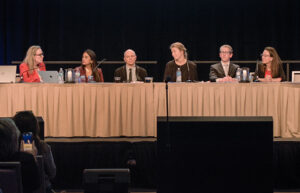


The final General Session at the 2025 San Antonio Breast Cancer Symposium® featured randomized clinical trials focused on interventions for supporting survivors and a timely prospective analysis addressing the impact of menopausal hormone therapy on breast cancer risk among germline BRCA1/2 mutation carriers. The session also included presentations on oncofertility counseling, an endocrine therapy-sensitivity assay, and updated data from the EMBER-3 and evERA trials.
A recording of the session, held Friday, December 12, is available on demand for registered SABCS® 2025 participants through March 31, 2026, on the virtual meeting platform.
GS3-01: Menopausal Hormone Therapy and the Risk of Breast Cancer in Women with a Pathogenic Variant in BRCA1 or BRCA2
A matched prospective analysis showed that menopausal hormone therapy (MHT) use was not associated with an increased risk of breast cancer in women with inherited germline BRCA1/2 mutations.
Women with BRCA1/2 mutations are known to have an increased risk of certain cancers, including breast, ovarian, and/or fallopian tube cancer.

“Unfortunately, even though it has been 30 years since we discovered these [BRCA1/2] genes, the best way to reduce a woman’s risk of dying [in BRCA1/2 carriers] continues to be bilateral salpingo-oophorectomy,” said Joanne Kotsopoulos, PhD, Professor at the Dalla Lana School of Public Health at the University of Toronto, who presented the findings.
This procedure involves the removal of the ovaries and fallopian tubes and per current guidelines is recommended before the age of 40 for germline BRCA1 carriers and before age 45 for germline BRCA2 carriers.
Dr. Kotsopoulos explained that since this surgery can induce early menopause, which can lead to increased comorbidities and chronic conditions, strategies to mitigate short- and long-term adverse impacts of bilateral salpingo-oophorectomy are needed.
While MHT can treat the symptoms of menopause, “there is a lot of hesitancy in using MHT in women both with and without a [germline BRCA] mutation,” Dr. Kotsopoulos said due to previous studies showing an increased risk of breast cancer, particularly from combination therapies with estrogen and progesterone.
In the matched prospective analysis, among 676 matched pairs of women who did and did not use postmenopausal MHT, the cumulative incidence of breast cancer among BRCA1/2-mutation carriers was higher among MHT nonrecipients (42.9%), compared with MHT recipients (24.5%).
The takeaway: MHT did not have an adverse effect on breast cancer risk in carriers of germline BRCA1/2 mutations.
Estrogen alone was associated with a lower breast cancer risk, irrespective of the route and formulation type.
“We did not see an increased risk with [estrogen-progesterone] combination therapy, which is also reassuring,” Dr. Kotsopoulos said.
Notably, only 37% of the around 6,000 women in the study’s cohort who had an oophorectomy and were eligible for MHT ever received a hormone therapy.
“We can do better; we can safely use MHT when it is indicated for this population,” Dr. Kotsopoulos concluded.
GS3-03: Randomized controlled trial of Young, Empowered & Strong (YES), an mHealth intervention for adolescent and young adult breast cancer survivors

The Young, Empowered & Strong (YES) mobile health intervention for adolescent and young adult (AYA) breast cancer survivors, which offered tailored support by monitoring electronic patient-reported outcomes (ePROs), significantly improved quality of life (QoL) and symptoms related to vaginal and arm problems, according to findings from a randomized trial presented by Ann H. Partridge, MD, MPH, Vice Chair of Medical Oncology and Chief Clinical Strategy Officer at Dana-Farber Cancer Institute.
“Breast cancer is the most common malignancy in AYAs, and the incidence is increasing globally,” Dr. Partridge said. “AYA breast cancer survivors experience substantial symptoms and concerns,” impacting not only QoL but also long-term decisions around adherence to endocrine therapy and follow-up care.
While serial monitoring of ePROs with extensive clinician involvement and monitoring improves outcomes for adults receiving chemotherapy, the value of ePRO-triggered survivor support and self-management with limited clinician input is unclear.
The YES web- and app-based tool provides tailored information and support based on ePRO responses from AYA breast cancer survivors. YES includes components that foster community-building among survivors and empower them to self-monitor and self-manage symptoms, and to self-advocate for clinical care.
Dr. Partridge and colleagues designed a randomized clinical trial to assess the impact of YES on AYA survivors’ QoL and symptoms at six months. After completing a baseline QoL survey, survivors — diagnosed with stage 1−3 breast cancer between ages 21−39, within three years of completing active treatment, and without evidence of recurrence — were randomly assigned 1:1 to participate in YES or to receive usual care.
Both general and cancer-specific QoL, as assessed using the Quality of Life in Adult Cancer Survivors questionnaire, was significantly improved at both three and six months among YES participants, compared with usual care recipients.
Dr. Partridge said that YES “represents a novel paradigm for supporting patients with low clinician touch in the survivorship period.”
GS3-04: Effects of Acupuncture vs. Sham Acupuncture and Usual Care on Cancer-Related Cognitive Difficulties Among Breast Cancer Survivors: The ENHANCE Randomized Clinical Trial
Real acupuncture was superior to sham acupuncture in improving objective cognitive function in breast cancer survivors, while both real and sham acupuncture improved perceived cognitive impairment, compared with usual care.
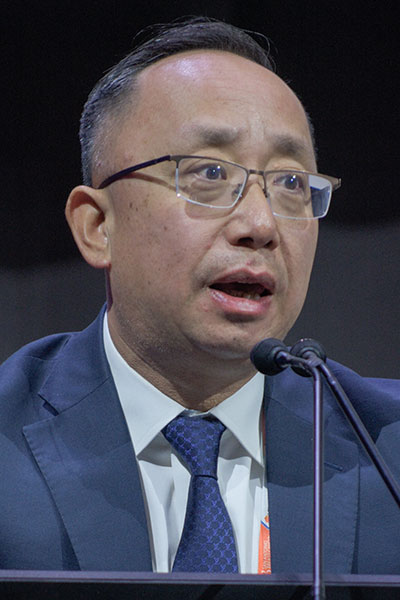
These findings from the prospective phase II ENHANCE randomized clinical trial were shared by Jun J. Mao, MD, MSCE, the Laurance S. Rockefeller Chair in Integrative Medicine and Chief of Integrative Medicine and Wellness Service at Memorial Sloan Kettering Cancer Center.
Dr. Mao said that cancer-related cognitive difficulties (CRCD) — also known as “brain fog” or “chemo brain” — are common, affecting up to 40% of breast cancer survivors. Currently, there is limited evidence to inform CRCD management.
The ENHANCE trial assessed the impact of acupuncture on perceived CRCD, per the Functional Assessment of Cancer Therapy-Cognitive Function (FACT-Cog) PCI questionnaire, and objective cognitive function, per blinded assessment using the Hopkins Verbal Learning Test-Revised, on breast cancer survivors who were experiencing both CRCD and insomnia.
The trial enrolled 260 survivors with a median age of 56.6 years; 53.5% had received chemotherapy, and nearly two-thirds were still receiving hormonal therapy with tamoxifen or aromatase inhibitors. Participants were randomly assigned 2:1:1 to real acupuncture, sham acupuncture, or usual care. Those in the sham acupuncture arm received a similar overall relaxing experience as those in the acupuncture arm, except the needles were taped so as not to penetrate the skin and were placed at locations not considered to be acupuncture points, Dr. Mao explained.
Real acupuncture was significantly more effective than usual care at reducing FACT-Cog PCI scores at both week 10 and 26, but there were no statistically significant differences between real and sham acupuncture.
Real acupuncture, however, was statistically more effective in improving objective cognitive function compared with sham acupuncture but showed similar results to usual care. In a small subset of patients who were found to have impaired objective cognitive function at baseline, real acupuncture was more effective than both sham acupuncture and usual care in improving memory.
Dr. Mao shared his interpretation of study findings for practicing medical oncologists: “The overall process of receiving acupuncture improved the [survivors’] subjective perception of cognitive impairment. I do think breast cancer survivors need to be heard, need to be validated, and need to be cared for in a therapeutic way.”
He added that the specific needling effect of acupuncture may offer additional benefits for objective cognitive function, but that needs to be verified in larger studies.
Additional abstracts presented during Friday’s General Session 3 include:
GS3-02: Fertility and ovarian function preservation in premenopausal women with early breast cancer: results from the multicenter prospective PREgnancy and FERtility (PREFER) study
GS3-05: Evaluation of the Sensitivity to Endocrine Therapy (SET ER/PR) assay to predict benefit from extended endocrine therapy in the NRG/NSABP B-42 trial
GS3-06: Rb Functions as a Transcriptional Activator of ER Targets Following CDK4/6 Inhibition in Luminal Breast Cancer
GS3-07: Risk-based breast cancer screening is safe, preferred by women and identifies highest risk individuals: Results from WISDOM 1.0
GS3-08: Imlunestrant with or without abemaciclib in advanced breast cancer (ABC): Updated efficacy results from the phase III EMBER-3 trial
GS3-09: Clinical and biomarker subgroup analysis of evERA Breast Cancer: A Phase III trial of giredestrant plus everolimus in patients with estrogen receptor-positive, HER2-negative advanced breast cancer previously treated with a CDK4/6 inhibitor