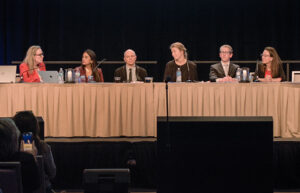


The partnership between breast oncologists and patient advocates has led to more effective science, increased funding for breast cancer research, and improved patient care, speakers said during a panel plenary lecture on Thursday, December 11, at the 2025 San Antonio Breast Cancer Symposium®.
The session, Partnership for Progress, will be available to registered SABCS® 2025 participants through March 31, 2026, as an on-demand recording on the symposium’s virtual platform.
Stronger together
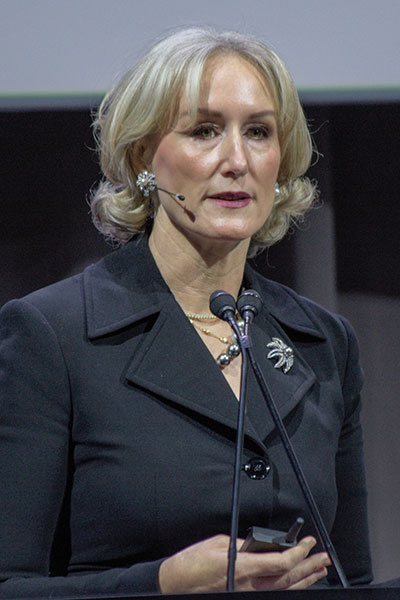
Debra Patt, MD, PhD, MBA, Executive Vice President for Policy and Strategy of Texas Oncology, opened the panel by noting that the breast cancer advocacy community owes a debt to AIDS activists, who largely pioneered the role of patient advocate communities in the 1980s and demonstrated how advocacy could translate into policies and science that could save and improve lives. The breast cancer community quickly adopted some of their most effective tools and lessons and developed unique approaches that integrated strengths of the scientific and patient and survivor communities.
“It is never more powerful than when you stand with allies to advocate together. Standing at the intersection is how we make change,” said Dr. Patt, a practicing breast oncologist who frequently joins patients and survivors in meeting with politicians to advocate and inform about policies and funding.
Combining the insights of experts in medicine, business, and policy are all important to making advances, she said, but the active and central involvement of patients and survivors remains essential for setting inclusion criteria for studies, defining toxicity limits in trials, and in convincing legislators of the importance and impact of research and funding.
“Elected officials listen to what I say as a doctor, but they listen way more to what patients have to say,” Dr. Patt said. “In my thousands of meetings, never have I met a public policy official or elected member of government who wants patients to do badly in their district — it’s never happened.” She added, however, that elected officials can sometimes “fail to see how the policies they pass translate into patient outcomes like access, like innovation, like clinical trials, like academic institutions. And if we don’t take the time to call it to their attention, how can we expect things to change?”
Advancing science
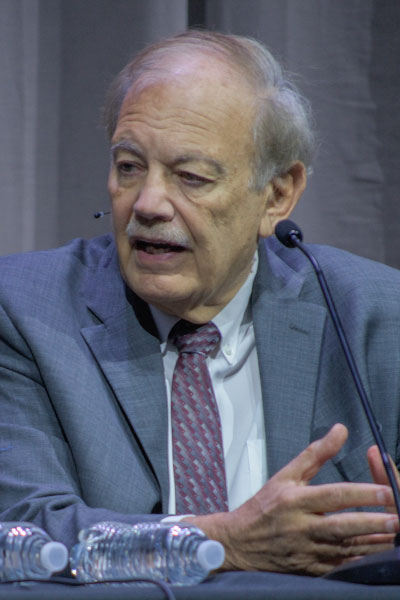
The breast cancer patient advocacy community was essential to overcoming skepticism from within the scientific community and providing support for research that led to the development of the transformative treatment of trastuzumab for human epidermal growth factor receptor 2 (HER2)-positive breast cancer, said Dennis Slamon, MD, PhD, Professor of Medicine, Chief of the Division of Hematology/Oncology, Director of Clinical/Translational Research, and Director of the Revlon/UCLA Women’s Cancer Research Program at the University of California, Los Angeles and the Jonsson Comprehensive Cancer Center.
Although he believes his research would have eventually succeeded, Dr. Slamon credits the advocacy community for helping to advance it by five to eight years.
“The work we were doing was about the same time as the evolution of a very active community in breast cancer,” he said. “I was able to interact and talk with those groups about what we were doing. It became a remarkable experience for me to realize that I was not talking to a separate group, I was talking to people who were true collaborators, who could work together with us in terms of doing the research, understanding policy advocacy for funding of this type of high-risk, high-benefit research, and also for implementing clinical trials in a time when many people had preconceived notions that this would not work.”
Since that time, Dr. Slamon said, the breast cancer patient and survivor community has been instrumental in helping to increase research funding, publicize the importance of trials, redefine acceptable side effects, center priorities based on how new treatments or therapies will impact patient lives, and more.
“It goes beyond participation. Advocates are true collaborators across the spectrum,” Dr. Slamon said, adding that because of the patient and survivor community, “breast cancer has led the way in the field of oncology in showing the impact that advocacy can have.”
Critical stories
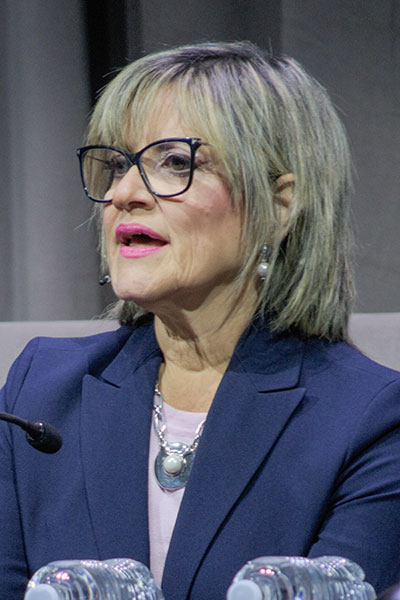
Drawing on her perspective as a health professional and a 22-year breast cancer survivor who has participated in study feedback processes, Bárbara Segarra-Vázquez, DHSc, said that advocates can be crucial to shaping policy and research and keeping the focus on patient lives.
Sometimes, patients have assisted by noting that a study might be “elegant, but not relevant” in terms of improving lives, said Dr. Segarra-Vázquez, Professor at the University of Puerto Rico School of Health Professions.
She noted that patients, particularly in underserved communities, can provide critical information, cultural awareness, and practical tips about reducing barriers to access or improving recruitment strategies.
This dialogue ultimately benefits both patients and researchers, since advocates can be the field’s most effective ambassadors, Dr. Segarra-Vázquez said.
“We can share our stories and people can understand the urgency. We can help the public understand the complexity of research,” she said.
To be an effective ambassador and to wade into the science can be daunting, Dr. Segarra-Vázquez acknowledged. She pointed to numerous groups willing to help new advocates become fluent in crucial scientific concepts as well as advocacy strategies, including the Latino Cancer Patient Advocate Training Program hosted by UT Health San Antonio and the Scientist↔Survivor Program from the American Association for Cancer Research (AACR).
Dr. Segarra-Vázquez concluded by speaking on behalf of patients and survivors to thank clinicians, researchers, and those in the breast cancer medical community.
She shared photos and life stories of several survivors, including a young mother with breast cancer who, after diagnosis, became afraid to grow closer to her child for fear that it would be too emotionally damaging if she died.
That mother has survived, and every story like hers is testimony to the progress both advocates and care providers have made by never giving up in their work against breast cancer, Dr. Segarra-Vázquez said.