

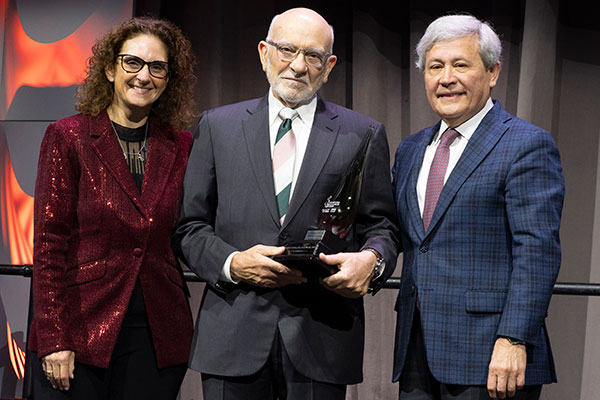
A leading figure in breast cancer surgery, Armando E. Giuliano, MD, urged attendees at the 2025 San Antonio Breast Cancer Symposium® to avoid becoming too entrenched in habits and instead seek out new ideas and approaches at all career stages in order to improve patient care.
“The only constant is change, but change is hard,” Dr. Giuliano said. “Changing medicine, especially surgery, is difficult and fraught with pain and strong resistance.”
Dr. Giuliano delivered the remarks to a standing ovation from the crowd Wednesday, December 10, during the William L. McGuire Memorial Award Lecture. A recording of the session will be available on demand for registered SABCS® 2025 participants through March 31, 2026.
Dr. Giuliano is the Chief of Breast Surgical Oncology and the Linda and Jim Lippman Chair in Surgical Oncology at Cedars-Sinai Medical Center; the Regional Medical Director for Cedars-Sinai Cancer, Breast Oncology; Associate Director of the Samuel Oschin Comprehensive Cancer Institute; Co-Director of the Saul and Joyce Brandman Breast Center – A Project of Women’s Guild; and Clinical Professor of Surgery at UCLA.
To those in the field of breast cancer, Dr. Giuliano is widely recognized for his pioneering work on sentinel lymph node biopsy, which transformed the standard of care and has allowed many patients to undergo less aggressive surgical intervention and lead a higher quality of life.
Dr. Giuliano drew on his personal successes — and his setbacks — around his career-defining studies to draw larger lessons about innovation and change.
Speaking about his experience leading up to the landmark results in his breakthrough ACOSOG Z0011 study on omitting axillary lymph node removal in limited node-positive breast cancer patients, Dr. Giuliano detailed intense hurdles. Early studies failed, and then — as studies began to produce results — he continued to face institutional rejection and criticism. This included a National Institutes of Health grant application review that said the “search for a sentinel node in breast cancer might be a magnificent surgical ‘tour de force,’ but without adding very much to the overall management of breast cancer,” which Dr. Giuliano said he regarded at the time as a crushing blow to his research career. He also received personal letters that accused him of “egregious” conduct with a study that showed “a lack of ethics.”
Dr. Giuliano said he was motivated to continue because he saw that his changes were keeping his patients safe. Eventually, his method led to results that showed statistically significant non-inferiority in overall survival between patients with limited node-negative disease who did or did not undergo axillary lymph node dissection.
And on February 9, 2011, The New York Times printed a cover story, “Lymph Node Study Shakes Breast Cancer Treatment,” about Dr. Giuliano’s study. The front-page article helped with public acceptance, but the field of breast cancer was also accepting the results, particularly after results were reproduced by colleagues.
“The procedure was accepted,” Dr. Giuliano said. “Why? Because it made sense anatomically and it was verifiable for each surgeon without risk.”
Dr. Giuliano said this experience was not just about one study or one surgeon who changed medicine at one time. He said he hopes his study has helped alter thinking about nodal metastases, how they are treated by systemic therapy, and whether nodal metastases lead to nodal recurrence — questions that other researchers are exploring and sharing insights about at SABCS.
And, Dr. Giuliano said, he hoped his experience sheds light on two concepts at the heart of effecting change in medicine.
The first of these concepts is what Dr. Giuliano called “the physician’s paradox.” It recognizes that every doctor and medical care provider makes important decisions in the lives of their patients, but that these decisions are informed by contradictory attributes: “Doctors are idea generators, we’re decision-makers, and we are among the most traditional, entrenched, conservative professionals,” Dr. Giuliano explained.
The second is the “end of history illusion,” an idea developed by psychologist Jordi Quoidbach, PhD, and others which states that people falsely believe that what they are today is who they will always be. Dr. Giuliano suggested that this thinking applies to people at all stages of their life and is “a great misconception.”
“Change is in everything, even in medicine and surgery,” Dr. Giuliano said. “You may change just the simplest things in your institution or in your practice, and it will be met with resistance. We are hard-wired to resist change. Most change is minimal, and still difficult. The fear of change is often worse than the change itself. If you dare to impart change, expect some pain. No matter how young you are, or how old you are — you can still change.”
The William L. McGuire Memorial Award Lecture, established in 1992, is given annually at the San Antonio Breast Cancer Symposium in recognition of an investigator whose extraordinary and sustained achievements in translational and/or clinical research have made an impact on our understanding of the pathogenesis and/or outcome of breast cancer patients. William L. McGuire, MD, founded SABCS along with Charles A. Coltman Jr., MD, and the first symposium was held in 1978.