

Experts explored the biological features, treatment considerations, and ethical nuances around young-onset breast cancer (YOBC) during a special session on Tuesday, December 9, at the 2025 San Antonio Breast Cancer Symposium®.
Special Session 3: Breast Cancer in Young Women: Biology, Treatment, and Ethics will be available to registered SABCS® 2025 participants through March 31, 2026, as an on-demand recording on the symposium’s virtual platform.
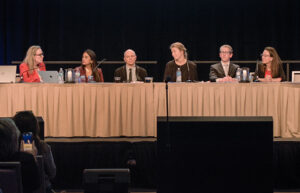
Ann H. Partridge, MD, MPH, Director of the Program for Young Adults with Breast Cancer, Vice Chair of Medical Oncology, and Eric P. Winer, MD, Chair in Breast Cancer Research at the Dana-Farber Cancer Institute, moderated the session.
Epidemiology and biology
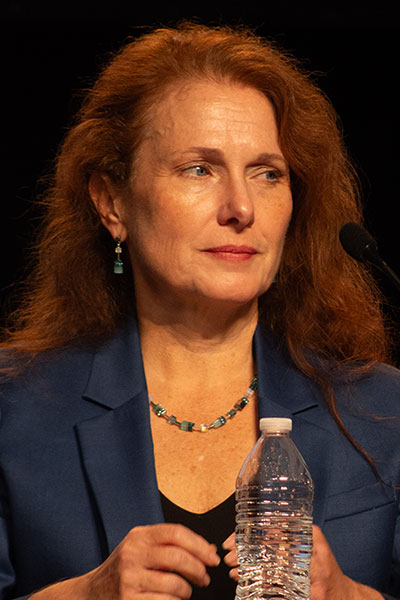
Historically, clinical trials have focused on the difference between pre- and postmenopausal patients, said Virginia F. Borges, MD, MMSc, Professor of Medicine-Medical Oncology at the University of Colorado Anschutz Medical Campus. However, she said, that premenopausal group is heterogeneous. It includes perimenopausal patients 45−50 years old, patients who are 36−45 years old, and an even younger subset of patients who were diagnosed before age 35.
“This matters depending on what question you want to ask,” she said, noting that in data about incidence rates, more pronounced trends in the patients over 40 may overshadow and obscure trends in younger subsets.
Dr. Borges reviewed differences in the epidemiologic trends across different world regions; biological, genomic, and clinical features; and the racial and ethnic distribution of breast cancer subtypes, based on the life-stage and age group in YOBC.
YOBC is “a disease of disparity,” Dr. Borges said, with worse overall outcomes in non-white populations in the U.S., in countries with less robust health care infrastructure, and in patients under 40 years old.
The list of YOBC-associated hereditary breast cancer genes is expanding, Dr. Borges said, highlighting the importance of genomic testing for both survivors of YOBC and their families. In this context, the OFSET and SWOG 0226 clinical trials are evaluating treatment approaches in premenopausal women with genomically-defined high-risk early-stage breast cancer.
Discussing the nuanced interactions between reproductive events and breast cancer risk over time, Dr. Borges noted that risk increases transiently in the first 10−20 years postpartum, while there is a protective effect of parity beyond 20 years and with prolonged lactation.
Dr. Borges concluded by discussing potential solutions for addressing the challenges with YOBC management, including development of trials focused on those younger than 45 and targeting realistic cultural changes to address modifiable factors.
Treatment decisions

Clinical management of YOBC is a multifaceted reality, said Yara Abdou, MD, MSCR, Assistant Professor of Hematology and Oncology at the University of North Carolina’s Lineberger Comprehensive Cancer Center.
“When we care for young breast cancer patients, it’s never just managing the tumor,” Dr. Abdou said, highlighting impacts on interconnected domains of the patient’s life — biology, fertility, mental health, and identity. Therefore, YOBC care “truly requires multidisciplinary coordination.”
For patients eligible for locoregional therapy, “one of the earliest and most emotional decisions” centers around surgery, she said.
“While young age does increase local recurrence risk, mastectomy does not necessarily translate into a survival advantage over breast-conserving surgery, granted the patient is getting the appropriate adjuvant therapy and doesn’t have an underlying genetic risk,” Dr. Abdou said. “Despite [these data], bilateral mastectomy rates continue to rise, often driven by MRI findings, reconstruction trends, and overestimated recurrence fears.”
Genetic testing and counseling to assess genetic risk should occur prior to surgical decision-making, she added.
Dr. Abdou reviewed clinical outcomes and potential reproductive health and quality-of-life implications of systemic therapy options for YOBC. While data on the fertility impacts of immune checkpoint inhibitors remain limited, she noted that ovarian toxicity, endocrine-related adverse events, and hormonal disruption caused by immune checkpoint inhibitors could impact libido or fertility.
For ovarian function suppression, the long-term benefits of this treatment in premenopausal women were greatest for women under the age of 35, but this benefit came with quality-of-life tradeoffs, according to Dr. Abdou.
She underscored the importance of shared decision-making throughout the treatment continuum, to address the individual patient’s concerns and support needs around fertility, pregnancy, therapeutic adherence, and survivorship.
Ethical considerations
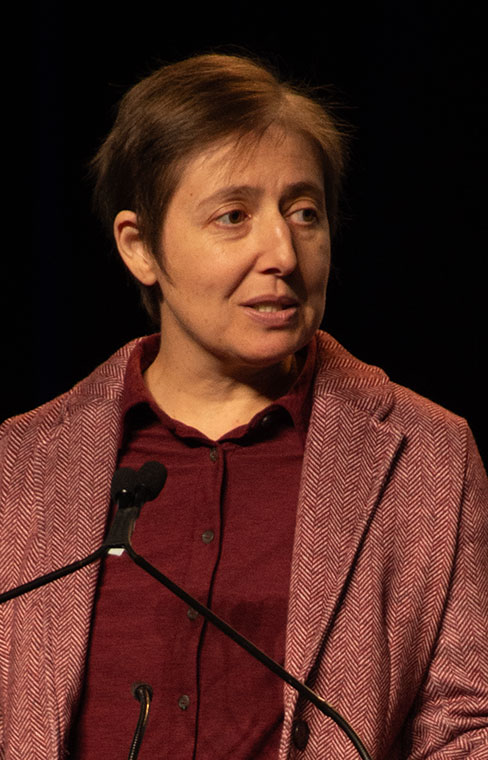
Lisa Campo-Engelstein, PhD, Professor and Inaugural Chair of Bioethics and Health Humanities at the University of Texas Medical Branch, looked at three case study examples through the lens of the ethical principles of patient autonomy, beneficence, nonmaleficence, and justice: a young transgender man diagnosed with breast cancer while receiving testosterone; balancing treatment timing and goals with fertility preservation in a young woman with triple-negative breast cancer; and a young woman diagnosed with breast cancer while in her first trimester of pregnancy.
Establishing a strong patient-clinician relationship built on transparency and trust, linking a patient to support networks, and prioritizing care are some of the ways that clinicians can help their patients navigate decisions in similar situations, Dr. Campo-Engelstein said.
Patient perspective
Patient Advocate Panelist Christine Hodgdon, Co-Founder of GRASP Cancer, shared her personal experience of delayed diagnosis at age 34. After discovering lumps in her breast and promptly going to a doctor, she was told that she was too young to have breast cancer and to not worry — an experience shared by many women with YOBC.
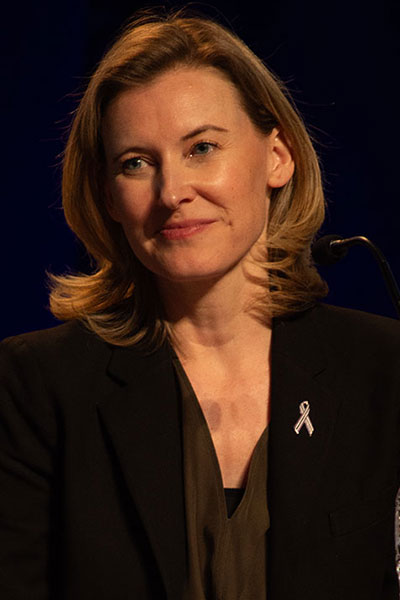
Hodgdon called attention to the stigma of being diagnosed with breast cancer at a younger age.
“Many people want to know what you did wrong — ‘why are you so young to be diagnosed?’” she said. “They’re trying to find out ‘what did you do, so that I don’t do that same thing and be diagnosed.’ This is something that becomes very isolating for people.”
She recalled feeling like she didn’t fit into existing support groups following her diagnosis of de novo metastatic breast cancer.
“When I would go to metastatic support groups, I was the youngest and the most healthy, and I was facing people who were in hospice and sad that they were going to leave their grandchildren. And I was still really reeling over the fact that I wasn’t going to have my own children,” she said. “But I have to credit the San Antonio Breast Cancer Symposium for helping me find my people. It was here that I connected with many advocates — many were metastatic and really in the same stage of life as me.”
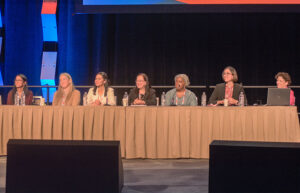
During the panel discussion, Hodgdon advocated for shared decision-making to help identify individualized practical solutions, and for enabling shared responsibility of care between patients and their providers.